
[HERO]
It’s a common thought process for many drivers in Garden City and Boise: “I barely drove my car this month, so everything must be fine.” On the surface, it makes perfect sense. If you aren’t putting miles on the odometer, you aren’t wearing down the brake pads, right?
Well, the truth is a bit more complicated: and potentially rustier. While your brake pads might not be getting thinner while the car sits in your driveway or garage, other components of your braking system are under a different kind of attack. In the automotive world, “disuse” is often just as hard on a vehicle as “overuse.”
If you’ve been wondering if you still need to look for brake repair near me even though your car has been sitting idle, here is the breakdown of what actually happens to your brakes when they don’t get used.
The Orange Enemy: Surface Rust and Pitting
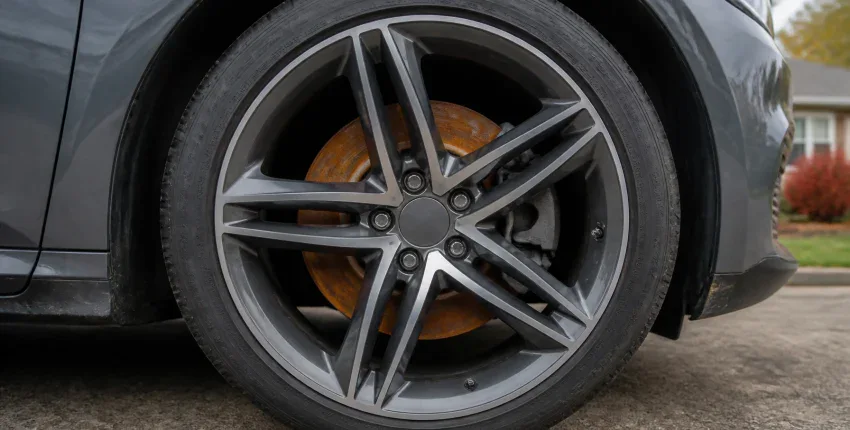
The most immediate thing that happens when a car sits is the formation of rust on the brake rotors. Most rotors are made of cast iron, which is incredibly strong but very susceptible to moisture. Even a humid night in Idaho can cause a thin layer of “flash rust” to form on the surface of your rotors.
If you drive every day, this isn’t an issue. The first few times you hit the brakes, the pads act like a piece of sandpaper, scrubbing that light rust right off. However, if the car sits for weeks, that rust can move from the surface and start “pitting” the metal. This creates an uneven surface that leads to vibrations, noise, and reduced stopping power. Instead of a smooth surface for your pads to grab, they’re trying to grip a rough, sandpaper-like disc.
Why Your Brake Fluid is a Moisture Magnet
Brake fluid is “hygroscopic.” That is a fancy way of saying it acts like a sponge for moisture in the air. Even when your car isn’t moving, the fluid in your lines is slowly absorbing tiny amounts of water through microscopic pores in the rubber hoses and the reservoir seal.
When you don’t drive, that water can settle in low points of the system, like your calipers or the ABS unit. Over time, this causes internal corrosion. You might not see it from the outside, but inside your braking system, the metal is slowly deteriorating. This can lead to a “spongy” brake pedal or, in worse cases, a complete failure of a component. This is why we often recommend regular brake fluid flushes regardless of how many miles you’ve driven.
The Case of the Stuck Caliper
Your brakes rely on moving parts: specifically pistons and slide pins: that need to slide freely every time you touch the pedal. When a car sits, these parts are prone to “seizing.”
Imagine a door hinge that hasn’t been moved in twenty years; it’s going to be stiff and hard to open. Your brake calipers are the same. Without regular movement to keep the lubricants spread and the rust at bay, the pistons can get stuck in place.
If a caliper seizes while you’re parked, you might notice the car feels “held back” when you finally try to drive it, or it might pull hard to one side when you brake. This is a major safety concern and a clear sign that it’s time to visit a professional for brake repair near me.

Signs Your “Idle” Brakes Need Attention
If your car has been sitting for a while, don’t just jump on the highway and hope for the best. Before you head out through Garden City or Boise, take a moment to check for these red flags:
- The Squeal or Grind: When you first move the car, do you hear a loud grinding noise? If it doesn’t go away after the first few stops, that rust has likely pitted the rotors.
- The Shudder: If the steering wheel shakes or the brake pedal pulses when you slow down, your rotors may have developed uneven spots from sitting too long.
- Soft Pedal: If the brake pedal feels like you’re stepping on a marshmallow and goes nearly to the floor, you likely have moisture or air in the lines.
- A Burning Smell: If you drive for five minutes and smell something “toasty” coming from one of the wheels, a caliper is likely stuck and dragging the brake pad against the rotor.
How to Protect Your Brakes When You Aren’t Driving
You don’t have to be a mechanic to prevent these issues. The best thing you can do for a car that doesn’t get much use is to take it for a “maintenance drive” once a week.
Drive it for at least 15 to 20 minutes: enough to get the engine up to temperature and, more importantly, to use the brakes. Making a few firm (but safe) stops from about 35 mph will help clear off surface rust and keep those caliper pistons moving.
It’s also worth scheduling a pre-purchase inspection or a general check-up if you’re planning to put a long-dormant car back on the road. We can check the health of your brake rotors and ensure your fluid is still effective.
Keeping Your Stops Safe in Garden City
At the end of the day, your brakes are the most important safety feature on your vehicle. Whether you’re driving a daily commuter or a luxury Maserati that only comes out on sunny Idaho weekends, those components need to work perfectly every single time.
Letting a car sit doesn’t “save” the brakes; in many ways, it subjects them to a different kind of wear and tear that can be even more expensive to fix if left ignored. If you’ve noticed any weird noises or a change in how your car stops, don’t wait for it to get worse.
The team at Wrench & Ratchet Auto Care is here to help with honest, straightforward pricing and expert service for all makes and models. If you’re concerned about how your car is handling after a long stint in the garage, give us a call or stop by our auto repair shop in Garden City. We’ll make sure you can hit the road with total confidence.