
Finding the perfect used car is a thrill. Whether you’re scouting for a reliable commuter for the Boise hills or a luxury Audi for weekend drives through Garden City, that moment you see a clean interior and a shiny coat of paint feels like a win. You’ve probably downloaded a DIY checklist from the internet, checked the oil, and kicked the tires. But here is the hard truth that every experienced mechanic knows: a clean appearance can hide a mountain of mechanical debt.
At Wrench & Ratchet Auto Care, we’ve seen countless buyers come in with a “new” car only to discover thousands of dollars in hidden repairs just weeks later. The reality is that modern vehicles are incredibly complex, and sellers, both private and professional, have become experts at masking issues long enough to get the title signed over. While a DIY inspection is a great first step to filter out the obvious clunkers, it simply cannot replace the depth of a professional look.
If you are currently searching for purchase inspections near me in the Garden City area, you are already on the right track to protecting your investment. Let’s dive into the invisible red flags that even the most diligent car buyers often miss.
The Myth of the “Clean” Dashboard
One of the first things any buyer looks at is the dashboard. No check engine light? Great. All the warning lights go off after you start the engine? Even better. Unfortunately, this is one of the easiest areas to manipulate.
Sellers can use a basic handheld scanner to clear “Check Engine” (CEL), ABS, or Airbag codes right before you arrive. Once cleared, those lights will stay off for a certain number of miles or driving cycles. You might drive the car home to Boise, and only the next morning will the computer finish its internal checks and realize something is still wrong. Suddenly, your “bargain” purchase is staring at you with a glowing yellow warning light.
During a professional pre-purchase inspection at our shop, we don’t just look for active lights. We check the “Readiness Monitors.” These are internal self-tests the car’s computer runs. If several monitors are in a “Not Ready” state, it’s a massive red flag that the battery was recently disconnected or the codes were recently wiped. We can also see “pending” codes, issues that have occurred but haven’t yet happened frequently enough to trigger the light on the dash.
Digital Deception and Diagnostic Depth
While a DIY buyer might bring a $20 scanner from a big-box store, it only scratches the surface. Those basic tools usually only read generic engine codes. Modern cars have dozens of computers (modules) controlling the transmission, airbags, body electronics, and climate control.
A professional inspection involves a deep-system scan. We look at the health of the engines and transmissions through the eyes of the vehicle’s central nervous system. We can see if the transmission has been overheating or if the airbag system has a history of communication failure. These are “invisible” because they don’t always make a sound or leave a puddle on your driveway.

Structural Integrity: The Dangers of Hidden Frame Damage
The most expensive red flag is frame or structural damage. If a car was in a major accident and repaired poorly, it may look perfect from the outside. However, the structural integrity of the vehicle is compromised. This isn’t just about the car driving straight; it’s about how the car will perform in another accident. A compromised frame may not fold correctly to protect you and your family.
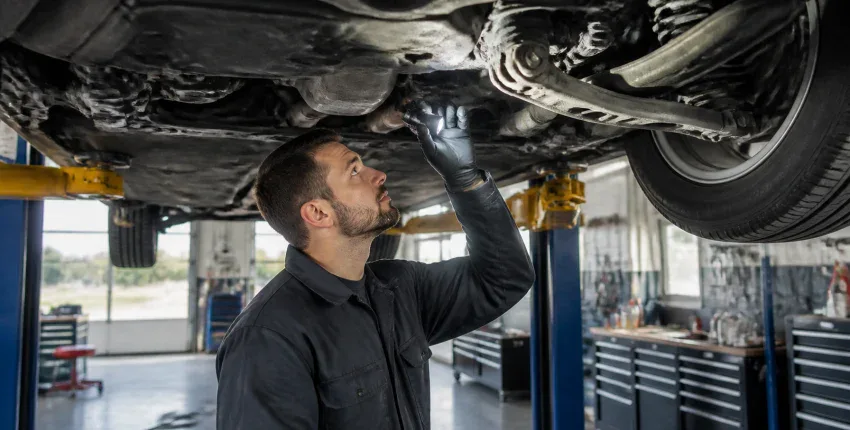
DIY buyers often look for mismatched paint or uneven body gaps, which are good signs. But a pro goes much deeper. We get the car on a hydraulic lift, something you can’t do in a grocery store parking lot. From underneath, we can see:
- Non-factory welds: Evidence that two parts of the car were joined together after a major wreck.
- Frame kinks or creases: Tiny ripples in the metal that indicate the vehicle took a structural hit.
- Cracked subframes: Essential for holding the engine and suspension services in place.
- Structural rust: While surface rust is common in Idaho, structural rot in the frame rails or mounting points can make a car legally or physically unsafe to drive.
The Secret Life of Fluids
Checking the oil level is standard. But do you know what the condition of the fluid is telling you? We’ve seen cars where the oil looked clean on the dipstick because it was just changed, but a look inside the filler neck revealed heavy sludge.
Sludge is the result of neglected oil changes over thousands of miles. It slowly chokes the engine from the inside out. We also look for “milky” oil, which is a classic sign of a blown head gasket, a repair that often costs more than the value of many older used cars.
Transmission fluid is another hidden storyteller. If the fluid smells burnt or has metallic flakes in it, the transmission is on its last legs. Most modern cars don’t even have a transmission dipstick anymore, making it impossible for a DIY buyer to check. Our technicians have the tools and expertise to verify these critical fluids so you aren’t left stranded on the side of the road.
Suspicious “New” Parts
Sometimes, a red flag looks like a green flag. If you see brand-new undercoating on an older car, a DIY buyer might think, “Oh, they took care of the rust!” To a trained mechanic, fresh undercoating is often a “can of spray paint” fix to hide deep structural rot or fresh accident repairs.
Similarly, brand-new tires on a car with only 20,000 miles might seem like a bonus. However, it can actually be a sign of a severe alignment or suspension issue that was “scrubbing” the original tires down to the cords prematurely. We check the auto repair Garden City ID standards for every component to see if things match the mileage and history of the vehicle.
The Benefit of the Lift: Suspension and Steering
Many “invisible” issues are only visible when the wheels are off the ground. When we perform a purchase inspection, we “shake down” the front end. This involves checking for play in ball joints, tie rod ends, and wheel bearings.
A car might feel fine during a 10-minute test drive at 35 MPH, but once you hit the highway heading toward Meridian or Boise, a worn-out suspension component can cause a dangerous “death wobble” or unpredictable steering. By the time you feel it, you’ve already bought the car. A professional catches these issues while the car is still the seller’s problem.
Why Wrench & Ratchet Auto Care is the Right Choice
When you look for purchase inspections near me throughout the Treasure Valley, you want a team that treats the car as if they were buying it for their own family. As a proud TechNet Professional Automotive Service member, Wrench & Ratchet Auto Care follows the highest standards in the industry.
Our shop is clean, professional, and organized. We don’t just give you a “thumbs up” or “thumbs down.” We provide a detailed report of what we found, what needs immediate attention, and what might become an issue in the next six months. This report is your best friend when it comes to negotiation. If we find $800 worth of brake and suspension work needed, you can use that information to ask the seller to drop the price: often paying for the inspection itself several times over.
Conclusion: Don’t Buy Someone Else’s Headache
Buying a used car is a major financial decision. A DIY checklist is a great tool for the initial walk-around, but it can’t see through cleared computer codes, identify structural “band-aids,” or feel the play in a hidden ball joint. The small cost of a professional inspection provides something priceless: peace of mind.
Before you hand over your hard-earned cash, let the experts at Wrench & Ratchet Auto Care give the vehicle a thorough vetting. We work on everything from your daily-driver Toyotas to luxury Maseratis and Bentleys, ensuring that whatever you drive, you’re driving safe.
Ready to buy with confidence? Call us today or visit our shop in Garden City to schedule your professional pre-purchase inspection. Let’s make sure your next car is a dream, not a nightmare!